
Adjectives: What Is an Adjective?
Adjectives: What Is an Adjective? A Complete Guide with Examples
Language allows us to express thoughts, emotions, and ideas clearly. One of the most important parts of speech that adds detail and meaning to language is the adjective. Without adjectives, sentences would sound plain and incomplete. This article provides a detailed explanation of what an adjective is, its types, usage rules, examples, and common mistakes. By the end, you will have a strong understanding of adjectives and how to use them effectively in both spoken and written English.
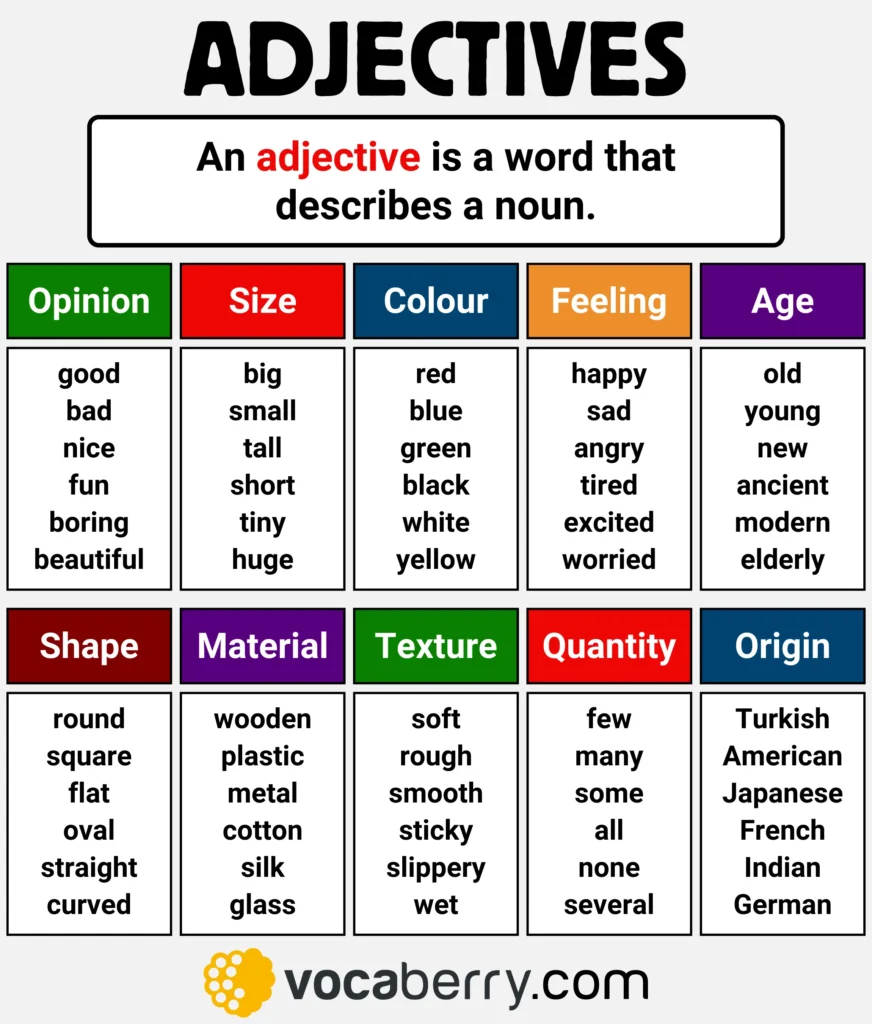
What Is an Adjective?
An adjective is a word that describes, modifies, or gives more information about a noun or pronoun. It helps answer questions such as what kind, which one, how many, or how much.
Example:
- She wore a beautiful dress.
- I have three books.
- This is my favorite movie.
In each example, the adjective adds clarity and detail to the noun What Is an Adjective
Why Are Adjectives Important?
Adjectives play a crucial role in communication. They help:
- Make sentences more descriptive and interesting
- Clarify meaning
- Improve creative writing
- Enhance academic and professional writing
Without adjectives, sentences would be vague and dull.
Example Without Adjectives:
- I saw a car.
Example With Adjectives:
- I saw a red sports car.
The second sentence paints a clearer picture.
Position of Adjectives in a Sentence
Adjectives usually appear in two main positions:
1. Before the Noun (Attributive Adjectives)
This is the most common position.
Examples:
- A large house
- An interesting book
- The blue sky
2. After a Linking Verb (Predicative Adjectives)
Adjectives can come after verbs such as is, are, was, were, seem, look, feel.
Examples:
- The house is large.
- She looks happy.
- The food tastes delicious.
Types of Adjectives
There are many types of adjectives in English. Below is a detailed explanation of the most common ones.
1. Descriptive Adjectives
Descriptive adjectives describe the quality, size, shape, color, or condition of a noun.
Examples:
- A beautiful painting
- A tall building
- A round table
- A clean room
These adjectives answer the question “What kind?”
What Is an Adjective
2. Quantitative Adjectives
Quantitative adjectives show how much or how many.
Examples:
- Some water
- Many students
- Few mistakes
- Enough money
They do not provide exact numbers.
3. Numerical Adjectives
Numerical adjectives indicate exact numbers or order.
Types of Numerical Adjectives:
- Cardinal: one, two, three
- Ordinal: first, second, third
- Multiplicative: double, triple
Examples:
- She bought three apples.
- This is the first chapter.
- He made a double effort.
- What Is an Adjective
4. Demonstrative Adjectives
Demonstrative adjectives point out specific nouns.
Common Demonstrative Adjectives:
- this
- that
- these
- those
Examples:
- This book is mine.
- Those shoes are expensive.
5. Possessive Adjectives
Possessive adjectives show ownership or possession.
Common Possessive Adjectives:
- my
- your
- his
- her
- its
- our
- their
Examples:
- This is my bag.
- She lost her keys.
6. Interrogative Adjectives
Interrogative adjectives are used to ask questions.
Common Interrogative Adjectives:
- which
- what
- whose
Examples:
- Which book do you want?
- Whose car is this?
7. Proper Adjectives
Proper adjectives are formed from proper nouns and always begin with a capital letter.
Examples:
- American culture
- Islamic history
- Pakistani food
Degrees of Comparison of Adjectives
Adjectives can show different degrees of comparison.
1. Positive Degree
The basic form of the adjective.
Example:
- She is tall.
2. Comparative Degree
Used to compare two people or things.
Example:
- She is taller than her sister.
Words like than are often used.
3. Superlative Degree
Used to compare more than two people or things.
Example:
- She is the tallest girl in the class.
Rules for Forming Comparatives and Superlatives
1. Short Adjectives
Add -er and -est.
- tall → taller → tallest
- fast → faster → fastest
2. Long Adjectives
Use more and most.
- beautiful → more beautiful → most beautiful
3. Irregular Adjectives
These change completely.
- good → better → best
- bad → worse → worst
Order of Adjectives
When multiple adjectives are used before a noun, they usually follow a specific order:
Opinion → Size → Age → Shape → Color → Origin → Material → Purpose
Example:
- A beautiful small old round brown Italian wooden table
Though native speakers often use this order naturally, learners benefit from understanding it.
Common Mistakes with Adjectives
Many learners make errors while using adjectives. Here are some common mistakes:
1. Using Adjectives Instead of Adverbs
Incorrect: She sings beautiful.
Correct: She sings beautifully.
2. Using Plural Adjectives
Incorrect: She has reds apples.
Correct: She has red apples.
Adjectives do not change for plural nouns.
3. Double Comparatives
Incorrect: She is more smarter than him.
Correct: She is smarter than him.
Adjectives in Creative Writing
Adjectives are essential in storytelling and descriptive writing. They help readers visualize scenes and characters.
Example:
- The dark, silent forest frightened the young, nervous traveler.
Too many adjectives, however, can weaken writing. Balance is key.
Adjectives vs Nouns
Some words can function as both adjectives and nouns depending on usage.
Examples:
- The poor need help. (adjective acting as noun)
- He bought a gold ring. (noun used as adjective)
Conclusion
Adjectives are one of the most important parts of speech in the English language. They enrich sentences, clarify meaning, and improve communication. From descriptive and possessive adjectives to comparative and superlative forms, understanding adjectives allows learners to write and speak more effectively. By practicing their usage and avoiding common mistakes, anyone can master adjectives and use them confidently in academic, professional, and creative contexts.
Frequently Asked Questions (FAQs)
1. What is an adjective in simple words?
An adjective is a word that describes a noun or pronoun by telling us more about it, such as its size, color, number, or quality.
2. Can adjectives be plural?
No, adjectives do not change their form for plural nouns.
Example:
- red apple
- red apples
3. How do I identify an adjective in a sentence?
Find the noun first, then look for the word that describes it. That word is usually the adjective.
4. What is the difference between an adjective and an adverb?
An adjective describes a noun, while an adverb describes a verb, adjective, or another adverb.
5. Can a sentence have more than one adjective?
Yes, a sentence can have multiple adjectives, but they usually follow a specific order.
6. Are numbers considered adjectives?
Yes, numbers are called numerical adjectives because they describe quantity or order.
7. What are proper adjectives?
Proper adjectives are formed from proper nouns and start with a capital letter, such as British, Islamic, or Asian.